


What happens when we slow down our breathing? Physiological effects, stress, blood pressure, sleep, and the limits of scientific evidence.
Slowing down your breathing is one of the simplest techniques used to calm yourself; by pausing for a few minutes and breathing more regularly, you may experience a sense of reduced tension and greater presence.
In recent years, broader benefits have been attributed to slow breathing: reduced stress, lower blood pressure, improved sleep and, more generally, better regulation of the autonomic nervous system.
But what actually happens when we slow down our breathing, and to what extent do the effects observed represent a health benefit?
- What does it mean to breathe more slowly?
- What happens in the body when we slow down our breathing?
- From physiological effects to health benefits
- There is no universal formula for breathing “better”
What does it mean to breathe more slowly?
In scientific research, slow breathing or slow-paced breathing refers to voluntarily slowing the breathing rate, generally to fewer than 10 breaths per minute.
Many studies focus on roughly 6 breaths per minute which is a rate of particular physiological interest because, for many, it aligns with what is known as the cardiovascular resonance frequency, the rhythm at which breathing and the cardiovascular system tend to become more closely coordinated.
However, this is not an optimal frequency or a threshold beyond which a benefit is necessarily achieved. Interest in 6 breaths per minute arises mainly from the physiological effects observed around this frequency, which in many people is close to cardiovascular resonance, rather than from evidence that it is the healthiest breathing rate overall.
It is also important to distinguish slow breathing from other practices that are often grouped together. Breathing slowly does not necessarily mean breathing more deeply, relying mainly on the diaphragm, extending the exhalation or practising a specific breathwork technique. This distinction matters because these components can produce different effects and are often used together.
What happens in the body when we slow down our breathing?
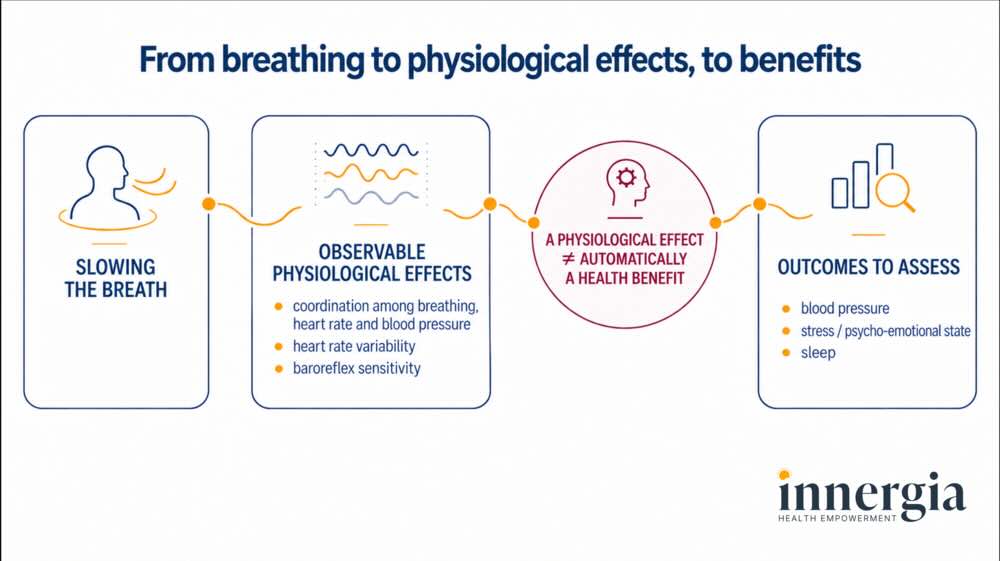
Breathing, heart rate and blood pressure are constantly interconnected. Even during spontaneous breathing, the heart tends to speed up slightly during inhalation and slow down during exhalation (a phenomenon known as respiratory sinus arrhythmia).
When breathing slows down, these fluctuations can become more pronounced. In particular, at around 6 breaths per minutehyp, the breathing rhythm can approach the natural frequency at which the system that helps regulate blood pressure oscillates (the baroreflex). As a result, breathing, heart rate and blood pressure can become more closely synchronized.
Slowing down the breath therefore produces real physiological effects that can be measured: by voluntarily acting on a function that is normally automatic, we can also influence other processes in the body. But not everything that changes in the body while we breathe more slowly automatically represents a health benefit.
From physiological effects to health benefits
Heart rate variability (HRV) is a good example. It describes how much the interval between one heartbeat and the next varies and, at rest, higher values may, in certain contexts, be associated with greater flexibility in autonomic regulation (the automatic regulation of functions such as heart rate, blood pressure and breathing).
During slow breathing, variability may increase partly because the breathing rhythm directly influences fluctuations in heart rate. An increase during the practice shows that the body is responding to the new breathing rhythm, but it is not enough to demonstrate a lasting improvement in health. Even after repeated practice over time, there is no consistent and sustained increase in resting heart rate variability.
Blood pressure presents a different picture. In individuals with hypertension, several studies report blood pressure reductions following slow-breathing programs, and a recent systematic review and meta-analysis found potentially meaningful reductions. However, the results are not consistent, and the protocols used vary considerably and often combine slow breathing with meditation, yoga techniques, music or biofeedback. In addition, not all studies show improvements in blood pressure measured over a 24-hour period. The signal is therefore interesting, but it does not allow us to attribute an antihypertensive effect with certainty to slowing the breath alone.
In terms of stress and psychological and emotional state, pausing and voluntarily regulating the breath can genuinely change the way we feel (reductions in perceived stress, anxiety or tension have been observed). In a randomized trial with an active control, however, when slow breathing was compared with another guided, rhythmic breathing pattern at a normal rate, the distinct advantage of slowing the breath disappeared.
Part of the benefit may therefore come not only from breathing more slowly, but also from pausing, temporarily interrupting the flow of thoughts, shifting attention towards the body and introducing a voluntary, regular rhythm. This does not make the benefit any less real; it simply means that not everything we experience during a breathing practice necessarily depends on how slowly we breathe.
As for sleep, some studies suggest an improvement in perceived sleep quality after an evening slow-breathing practice. However, the evidence is still limited and does not allow us to conclude that slow breathing consistently improves the objective architecture of sleep.
Overall, slow breathing may have beneficial effects, but they are not all equally well established, nor do they necessarily depend on breathing more slowly.
There is no universal formula for breathing “better”
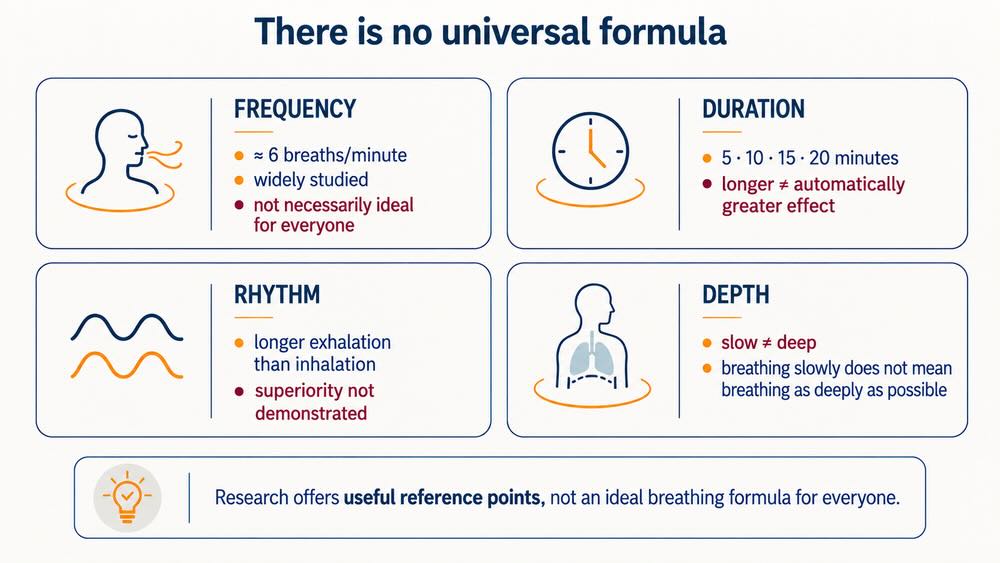
Research has not identified a breathing frequency, duration or rhythm that is optimal for everyone. Around 6 breaths per minute is a widely studied frequency, but not necessarily the ideal one for every person. Likewise, there is no clear relationship between sessions lasting 5, 10, 15 or 20 minutes and the magnitude of the heart rate variability response.
Rather than trying to follow a precise formula, it is therefore more important to avoid forcing the breath. Breathing slowly, for example, does not mean breathing as deeply as possible. If the volume of each breath is increased too much, ventilation can exceed what is needed, CO₂ levels may fall, and dizziness, tingling, shortness of breath or discomfort may occur. Reported adverse effects are generally mild, although they are still not monitored systematically enough. If the practice causes discomfort or a feeling of air hunger, there is no reason to push through it.
The value of slow breathing therefore does not seem to depend on practising one specific technique considered effective for everyone. Rather, it lies in the possibility of pausing and consciously influencing a function that is normally automatic, affecting some physiological processes and, in many cases, also the way we perceive our own state. Understanding what we can realistically expect allows us to use this possibility without turning it into a miracle technique or a rigid rule.

SCIENTIFIC SOURCES – Selection for further reading
– The physiological effects of slow breathing in the healthy human — Breathe, 2017
– Heart rate variability and slow-paced breathing: when coherence meets resonance — Neuroscience & Biobehavioral Reviews, 2022
– Effects of voluntary slow breathing on heart rate and heart rate variability: A systematic review and a meta-analysis — Neuroscience & Biobehavioral Reviews, 2022
– Voluntary Slow Breathing Exercise on Cardiovascular Parameters in Patients With Hypertension: A Systematic Review and Meta-Analysis — Clinical Cardiology, 2026
– Device and nondevice-guided slow breathing to reduce blood pressure in hypertensive patients: A systematic review and meta-analysis — Health Science Reports, 2022
– Effect of coherent breathing on mental health and wellbeing: a randomised placebo-controlled trial — Scientific Reports, 2023
– Influence of a 30-Day Slow-Paced Breathing Intervention Compared to Social Media Use on Subjective Sleep Quality and Cardiac Vagal Activity — Journal of Clinical Medicine, 2019
– Single Slow-Paced Breathing Session at Six Cycles per Minute: Investigation of Dose-Response Relationship on Cardiac Vagal Activity — International Journal of Environmental Research and Public Health, 2021
– Slow breathing for reducing stress: The effect of extending exhale — Complementary Therapies in Medicine, 2023
– An Anti-hyperventilation Instruction Decreases the Drop in End-tidal CO₂ and Symptoms of Hyperventilation During Breathing at 0.1 Hz — Applied Psychophysiology and Biofeedback, 2019
