


Exercising regularly and spending many hours sitting can go hand in hand. Discover what research says about sedentary behaviour, physical activity and everyday movement.
You can go to the gym three times a week, run, play tennis or exercise regularly and still spend much of your day sitting. This is a very common situation, especially for people who work at a computer or spend a lot of time driving. Exercising and being sedentary are not opposite conditions. And knowing whether we exercise is not enough to understand how active we really are.
Physical exercise, everyday movement and sedentary time are different dimensions, but they interact with one another. This is why it is useful to look not only at exercise, but also at how movement is distributed throughout the day.
Contents
- Sedentary behaviour and physical inactivity are not the same thing
- How much time you spend sitting also matters for your health
- Can physical activity offset many hours of sitting
- It is not just about exercise: what matters is how you move throughout the day
- After 50, movement is also an investment in the future
Sedentary behaviour and physical inactivity are not the same thing
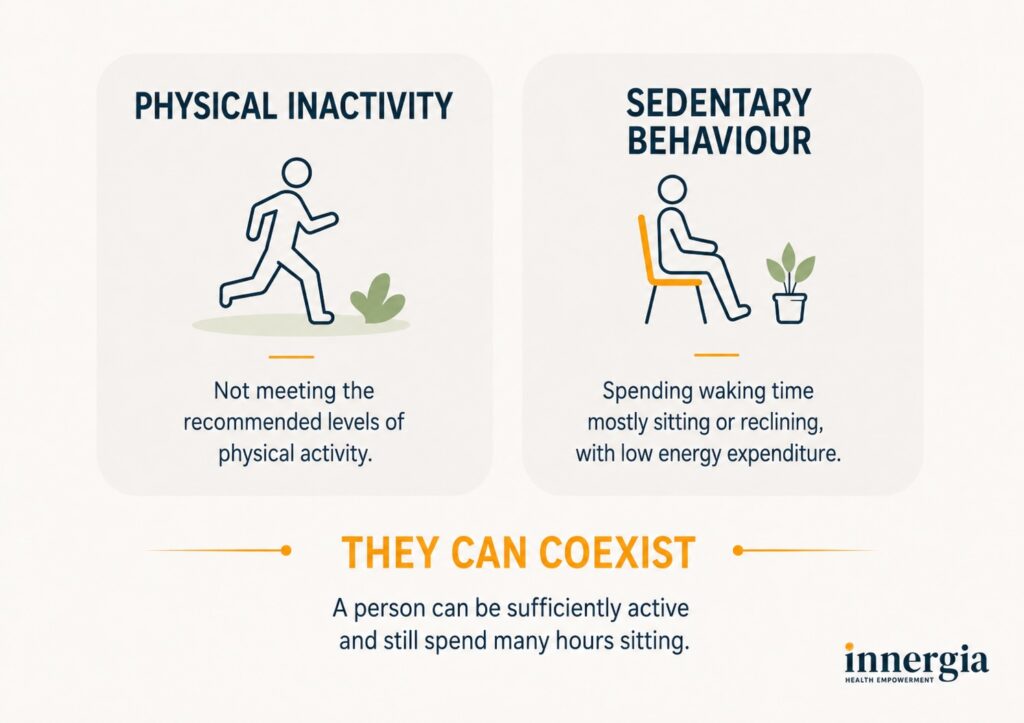
In everyday language, we tend to describe someone who does little exercise as sedentary. From a scientific perspective, however, sedentary behaviour and physical inactivity refer to two different conditions. Being physically inactive means not meeting the recommended levels of physical activity, while sedentary behaviour refers to time spent awake mainly sitting or reclining with very low energy expenditure.
It is therefore possible to meet physical activity recommendations while also accumulating many hours of sedentary time. Exercise represents only one part of our overall daily movement. What happens before and after also matters: how much we walk, how much we move around, how much time we spend sitting and how many opportunities we have to move during normal daily activities.
The question, therefore, is not only “Am I getting enough exercise?”, but also “How am I spending all the other hours of my day?”
How much time you spend sitting also matters for your health
In recent years, scientific research has increasingly examined sedentary behaviour as distinct from insufficient physical activity. The evidence shows an association between high levels of sedentary time and a greater risk of premature mortality and cardiovascular disease. Associations have also been found with type 2 diabetes and other indicators of metabolic health.
This does not mean, however, that there is a precise number of hours beyond which sitting suddenly becomes dangerous. Studies show a relationship between the amount of sedentary time and risk, but estimates vary depending on the populations studied, the outcomes considered and the way sedentary behaviour is measured. Results obtained through questionnaires, for example, do not always match those derived from accelerometers and wearable devices.
For this reason, international guidelines recommend limiting sedentary time, without setting a daily threshold that applies to everyone.
It is also important to remember that much of the evidence comes from observational studies: the association with risk is consistent, but not every association can automatically be interpreted as a direct cause-and-effect relationship.
Can physical activity offset many hours of sitting?
If high levels of sedentary time are associated with greater risk, what happens to people who exercise regularly? This is where the research becomes particularly interesting. Physical activity strongly modifies the association between sedentary behaviour and health. The less favourable effects of spending a great deal of time sitting are seen especially in people who engage in little physical activity.
An key finding comes from a harmonised meta-analysis published in 2020 in the British Journal of Sports Medicine, based on more than 44,000 middle-aged and older adults monitored with accelerometers. The researchers found that around 30–40 minutes per day of moderate-to-vigorous physical activity attenuated the association between sedentary time and mortality. The authors also pointed out that this estimate was lower than estimates previously obtained using self-reported data: it should therefore not be interpreted as a universal threshold or as a “magic” amount of exercise capable of cancelling out sedentary behaviour.
The real message is that physical activity and sedentary time need to be considered together. Saying that exercise makes all the hours spent sitting irrelevant would be an oversimplification. But it would be equally wrong to claim that a sedentary day automatically cancels out the benefits of exercise.
The least favourable situation, and one that is fairly intuitive, is the combination of high sedentary time and low physical activity.
It is not just about exercise: what matters is how you move throughout the day
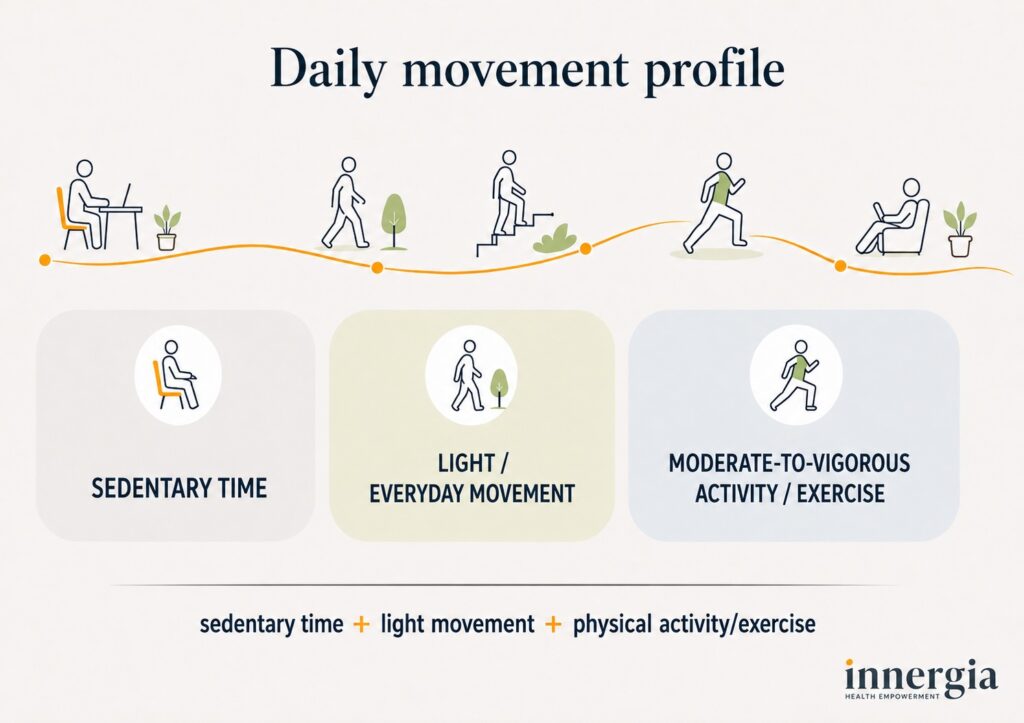
Thinking about movement only in terms of “exercise or no exercise” can therefore be reductive. Between sitting and intense exercise lies a broad range of walking, taking the stairs, travelling on foot, household activities, breaks from work and light movement accumulated throughout the day.
Light physical activity is not equivalent to moderate or vigorous activity and does not necessarily produce the same effects. However, the evidence suggests that replacing some sedentary time with movement is generally a favourable choice.
Breaking up a long period of sitting with a few minutes of movement can also produce immediate metabolic effects. A systematic review and meta-analysis published in 2026 in the European Journal of Preventive Cardiology, which synthesised 144 studies and 247 experimental interventions, found favourable effects on blood glucose, insulin and blood pressure. More frequent interruptions appear to matter particularly for blood glucose, while for other parameters, such as triglycerides, the duration and intensity of movement appear to become more important.
There is, however, an important point to clarify: these findings mainly concern acute effects observed under experimental conditions. We still do not know with the same degree of certainty how often breaks should occur to produce long-term clinical benefits in everyday life.
This therefore does not mean that everyone should set an alarm every 20 or 30 minutes. The frequencies used in studies do not yet represent a universal recommendation. The point is not to add another rule, but to broaden our perspective: not only how much we exercise, but how much movement we manage to distribute across the hours when we are not exercising.

After 50, movement is also an investment in the future
There is no biological threshold at age 50 beyond which sedentary behaviour suddenly becomes more dangerous. Many studies on ageing involve people over 60 or over 65 and cannot automatically be applied to someone who has just turned 50. From midlife onwards, however, it can become particularly useful to look at movement from a longer-term perspective as well.
Physical activity is not only about preventing chronic disease. As the years pass, mobility, physical function and independence become increasingly important: continuing to walk well, move with ease, carry out everyday activities and retain the ability to do the things that matter to us.
Studies in older adults show favourable associations between higher levels of physical activity and various indicators of function and independence. Once again, the overall picture appears to matter more than just the amount of time spent sitting.
For this reason, it can be useful to look at a typical day and ask yourself: How much time do I spend sitting? How much do I move when I am not exercising? Where could I add more movement without disrupting my routine?
Large changes or new rigid rules are not necessarily required. Sometimes the first step is simply recognising that exercise is important, but our relationship with movement continues throughout all the other hours of the day.
FONTI SCIENTIFICHE – Selezione per approfondire
– Guidelines on physical activity and sedentary behaviour – WHO
– Shared definitions of sedentary behaviour, physical inactivity and related concepts – International Journal of Behavioral Nutrition and Physical Activity
– Sedentary behaviour and risk of mortality, cardiovascular disease and type 2 diabetes – European Journal of Epidemiology
– Dose-response associations between physical activity, sedentary time and mortality – BMJ
– Interaction between physical activity, sedentary time and mortality in more than 44,000 adults – British Journal of Sports Medicine
– Sedentary time, physical activity intensity and cardiovascular mortality – International Journal of Behavioral Nutrition and Physical Activity
– Effects of movement breaks during prolonged periods of sedentary behaviour – European Journal of Preventive Cardiology
– Physical activity and sedentary behaviour in older people – WHO
You can read the Italian version of this article here >
